

API mocking in 2023

API mocking tools
There are a number of different tools available for mocking APIs.
The best tool for mocking an API will depend on your specific needs and requirements:
If you are looking for a comprehensive mocking tool with a wide range of features, then WireMock is a good choice.
If you are looking for a cloud-based mocking tool that is easy to use, then Mockoon or Mocko are good choices.
If you are already using Playwright for your end-to-end tests, then it can also be used to mock APIs.
WireMock
WireMock is a popular open source tool for mocking APIs. It is easy to use and provides a wide range of features, such as the ability to generate mock responses for different HTTP methods and status codes, stub out dependencies, and simulate different scenarios. WireMock also supports recording and replaying real API traffic, which can be useful for debugging and testing purposes.
Pros:
Easy to use
Wide range of features
Supports recording and replaying real API traffic
Cons:
Can be complex to set up for more advanced scenarios
Mockoon
Mockoon is a cloud-based API mocking tool that is easy to use and provides a wide range of features. It allows developers to create mock APIs in minutes, without having to write any code. Mockoon also supports a variety of authentication mechanisms and can be used to simulate different scenarios.
Pros:
Easy to use
Cloud-based
Supports a variety of authentication mechanisms
Cons:
Some features are only available in the paid plan
Playwright
Playwright is a relatively new tool for mocking APIs. It is a popular choice for developers who are already using Playwright for their end-to-end tests. Playwright allows developers to mock APIs by intercepting and handling network requests. This can be done using the page.route() method.
Pros:
Easy to use for developers who are already using Playwright
Can be used to intercept and handle network requests
Cons:
More limited features than other mocking tools
Not as widely used as other mocking tools
Mocko
Mocko is a cloud-based API mocking tool that is easy to use and provides a wide range of features. It allows developers to create mock APIs in minutes, without having to write any code. Mocko also supports a variety of authentication mechanisms and can be used to simulate different scenarios.
Pros:
Easy to use
Cloud-based
Supports a variety of authentication mechanisms
Free plan available
Cons:
Some features are only available in the paid plan
Tool comparison
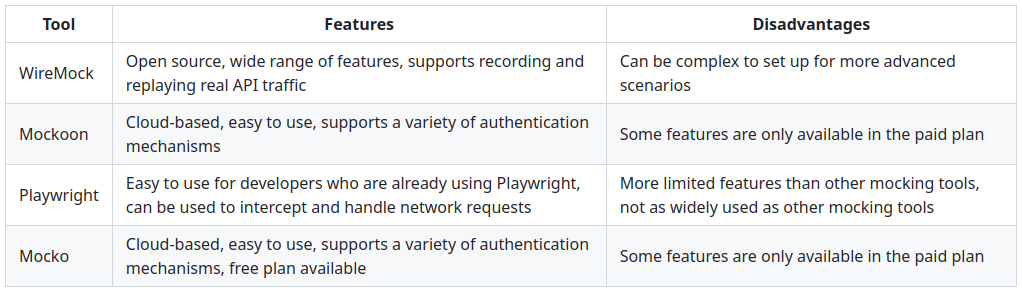
Here is a table summarizing the most important features and disadvantages of the four API mocking tools mentioned before:
API Mocking and E2E
E2E testing is a type of testing that tests the entire system, including the API layer. By mocking the API layer in E2E testing, you are not testing the real API and you may miss potential problems.
In general, API mocking is considered an anti-pattern in E2E testing due to the following reasons:
It can lead to false positives. If the mock API does not accurately simulate the real API, then your E2E tests may pass even though there are problems with your code.
It can make it difficult to debug problems. If an E2E test fails, it can be difficult to determine whether the problem is with your code or with the mock API.
It can give you a false sense of security. If all of your E2E tests pass, you may think that your system is working correctly, even though there are problems with the API layer.
Despite all this, are there any use cases where API mocking is an acceptable technique in E2E testing? There are lots of cases where this is acceptable:
An API that is not yet available. When developing a new feature that depends on an API that is not yet available, you may need to mock the API in order to test your feature.
An API that is slow or unreliable. If the real API is slow or unreliable, then it may make it difficult to run your E2E tests effectively. Mocking the API in this case may speed up tests and make them more reliable.
Testing a specific scenario that is difficult to reproduce with the real API. For example, when testing a scenario that involves a lot of data or that involves multiple API calls. In this case, a mocked API will help to create a controlled test environment.
If after analyzing the current needs of our tests we conclude that we need to mock the API layer, we should observe the following ideas to reduce risks associated with mocking:
Only mock the API layer when necessary.
Use a mocking framework to simplify the process of creating mock responses.
Test the mock API to ensure that it is working as expected.
Document the reasons why you are mocking the API layer and the scenarios that you are testing.
Example of mocking an API with Playwright
A basic example of mocking an API with Playwright requires intercepting and handling the network requests of interest.
// General example
// Sets a RESPONSE_BODY mock for the API endpoing and then calls it
await page.route("/api/me", async route => {
  await route.fulfill({ RESPONSE_BODY })
});

const response = await page.goto("https://www.example.com/api/me");
Should I mock my API for testing?
API mocking is a powerful technique that can be used to improve the quality of your code and reduce the risk of problems in production. However, it is important to use mocking responsibly.
With API mocking the developer creates a simulated version of an API endpoint. This can be useful for testing purposes, as it allows developers to test their code without having to rely on the real API.
In general, mocking an API allows developers to test their code in isolation, to simulate different scenarios, to stub out dependencies, and to test the performance of their code. But for the particular case of E2E testing, API mocking is generally considered an anti-pattern, as it can lead to false positives, make it difficult to debug problems, and give you a false sense of security. However, there are a few caveats where API mocking may be acceptable in E2E testing, such as if the API is not yet available, if the API is slow or unreliable, or if you need to test a specific scenario that is difficult to reproduce with the real API. Valuable comment
When deciding whether or not to mock an API in E2E testing, it is important to weigh the benefits and risks. If there is a good reason to mock the API, such as if the API is not yet available or if the API is slow or unreliable, then the benefits may outweigh the risks. However, if there is no good reason to mock the API, then it is best to err on the side of caution and test the real API whenever possible.
Do you want to know more?
That's where we come in. At Kizmet Solutions, we're experts in data architecture, E2E testing, automation pipelines, and data engineering. And we're here to help you implement API mocking in your own projects, so you can reap the benefits of faster development, fewer bugs, and happier customers.
Contact us today for a free consultation, and let's see how we can help you take your software to the next level.